March 02, 2015

02/03/2015: CropTech-FeedTech Debate at VIV Asia - Register now

It’s just over a week to the opening of VIV Asia, the East’s leading trade show for professionals involved in all aspects of livestock production and processing.

Indeed, the entire concept behind VIV Asia can be summed up in just three words: ‘Feed to Meat’. VIV Asia will feature exhibitors and industry developments from every stage of the meat, seafood and dairy production processes.
 

http://www.vivasia.nl/en/Bezoeker/Conferences/CropTech-FeedTech.aspx

With nearly 900 exhibitors from across the globe, the show promises to offer a wide range of trading and networking opportunities for all attendees. 

A range of special events and conferences will also be on offer, including the CropTech-FeedTech Debate.

Offering seven companies an open forum in which to present and discuss their digital technology and its impacts on feed production, this promises to be a stimulating event in which audience participation will be welcomed.

The program in outline:
Thursday March 12, 2015 - Meeting Room 225
15.30 hrs - 17.00 hrs

1) Introduction by Roger Gilbert, publisher of Milling and Grain magazine.


2) Eight-minute Company Presentations by:

•    Adifo
•    Agentis Innovations
•    Amandus Kahl
•    The Feed Guys
•    Foss Analytical AS
•    Muyang Holdings
•    Wenger Manufacturing Inc

3) Fifteen-Minute Debate where participating companies will have an opportunity to discuss developments arising among themselves and answer questions posed by the moderator.

4) Fifteen-Minute Question & Comment Period where attendees will be invited to comment or question presenters about their technologies and their views relating to the manner in which digital technology is being introduced to feed manufacturing.

Just 90 minutes out of your day....
Don’t miss this chance to have your say.


To register, click HERE.


The Global Miller
This blog is maintained by The Global Miller staff and is supported by the magazine GFMT
which is published by Perendale Publishers Limited.


For additional daily news from milling around the world: global-milling.com

02/03/2015: Silo safety - A comprehensive overview on silo safety guidelines

by Portasilo, UK

first published in Milling and Grain, January 2015

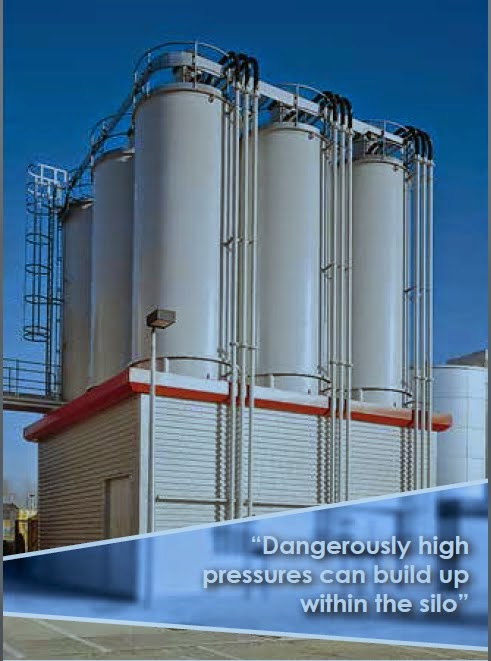
Silos that are filled directly from a pressurised tanker need to incorporate suitable mechanisms to allow displaced air within the silo to escape during filling. If these mechanisms are insufficient for the pressures created within the silo, or if the equipment is poorly maintained and becomes inefficient, dangerously high pressures can build up within the silo. 
 
This can lead to a catastrophic blow out, damaging plant and equipment, dispersing possibly toxic silo contents over a wide area and endangering the lives of employees.
In this report, we bring together all of the guidance and recommendations into a single, easy-to-understand guide to safeguarding your plant against silo over-pressurisation. At the same time, we highlight the implications of the HSE and Defra guidance for silo safety equipment.


Prepare for peak airflow

One of the major changes to existing assumptions outlined in the HSE document was the need to specify silo safety equipment to cope with a peak airflow from the silo of 13,000m³/hour. The previous assumption had been that peak airflow caused by over-pressurisation during tanker filling could only reach around 2000m³/hour. 


http://issuu.com/gfmt/docs/mag1501/42
To test the new assumption, Portasilo built its own test rig and modelled a variety of over-pressurisation incidents. The company found that it was possible to reach peak airflow from the silos of almost 13,000m³/hour as a result of over-pressurisation. The next step was to investigate the ability of existing safety equipment to cope with this increased airflow and, where necessary, redesign it. 


Silo filters – the first line of defence
All silos that receive pressurised tanker deliveries must be fitted with a filter in the roof. This allows displaced air from within the silo to escape to the atmosphere. Portasilo tests found that filter sizes and specifications did not need to be changed in response to the new peak airflow assumptions in the HSE guidelines. If properly sized and maintained, existing filters could already cope with an airflow of 13,000m³/hour and it was our assumed minimum filter velocity that had changed not the requirement for more filter area.


However, regular filter maintenance is essential to sustain the required levels of performance. Silo filters incorporate filter bags to prevent dust escaping into the atmosphere. These bags must be regularly cleaned to prevent clogging which could inhibit the free outflow of air from the silo.


A number of automated filter cleaning mechanisms are available, but the most efficient and effective are reverse jet-cleaned filters. These systems use jets of air to blow the dust from inside the filter bags. It’s also important that the air supply to the filter is clean and dry. Moist air can quickly exacerbate the clogging of filter bags, particularly with particulate powder silos. 


Pressure relief valves – the last line of defence
If pressures within a silo build up to such an extent during filling that the filter cannot release enough air to maintain silo pressure within safe limits, the pressure relief valve (PRV) is triggered. This valve is designed to open below the design pressure of the silo.


Each pressure relief valve is designed to open at a particular ‘set pressure’. 


PRVs contain a plate, which lifts up when pressure reaches the ‘set pressure’, releasing air to the atmosphere and immediately reducing pressure within the silo. The plate is held in place either by springs or by a dead weight, depending on the design. 


Implications of the new guidelines for PRVs
Given the new guidelines for a maximum 13,000m³/hour airflow from the tanker, it is essential that PRVs are sized for this maximum potential out-breathing. Many PRVs on the market at the time the guidelines were released were not large enough to allow this volume of air to pass through, potentially allowing dangerous pressures to build up inside the silo.


Investigations also found that some spring-type valves could become coil-bound and weren’t opening properly. This could cause dangerous pressure build-ups in the silo. When tested, such coil-bound valves caused air to accumulate within the silo by preventing it from escaping at the required rate. The silo’s design pressure is quickly exceeded in these conditions, with potentially catastrophic results. 


Choosing an effective PRV

When choosing a PRV you should look for a model that has been tested and certified for a specific volumetric capacity and set pressure. The volumetric capacity of the valve should be 13,000m³/hour to meet HSE guidelines and you should choose a PRV with a set pressure slightly lower than the design pressure of your silos.


Some PRVs are now 350mm in diameter, to cope with the greater volumetric capacity requirements – many were previously 250mm across. You should also choose a valve with long travel springs that will not become coil bound over time, reducing the effectiveness of the valve. Some PRV manufacturers use the same spring specification for all sizes of valve and adjust them to open at higher pressures. 


This can lead to inconsistencies in performance, especially if end users at the plant later adjust the springs. A more reliable system is to use different specifications of spring for each PRV specification. It means there is no room for human error in spring tightening, as the spring properties are set at manufacture and cannot be adjusted by the end user.


http://issuu.com/gfmt/docs/mag1501/42
It is good practice to choose a PRV with a set pressure below the design pressure of your silo, but not so close that even the slightest PRV inefficiency or delay would cause the silo design pressure to be exceeded. 

Another problem with some PRV designs is that the weather-proof cover can impede air flow through the valve. In testing, the valve works perfectly well without a cover, but once a cover is fitted, it’s shape can inhibit the free flow of air. Try to look for a PRV that has an aerodynamic cover that flares out at the edges, allowing air to pass freely. 


As well as allowing air to escape from the silo, PRVs also help to relieve under-pressure or vacuum situations within the silo by allowing air to flow in from the outside. Tests of older Dead Weight type PRVs found that the inflow mechanism was often susceptibleto dust clogging, making them inefficient. Once again, it’s important to choose tested and certified PRVs, preferably with an inflow capacity of 5000m³/hour.


Auto shut-off – your early warning system
PRVs should always be considered a last line of defence. Ideally, pressure build-ups should be alleviated before the PRV is triggered. That’s because when the PRV opens, it will emit dust from the silo over a wide area, with potentially harmful consequences for human health and the environment. 


Automated warning and shut-off systems can be installed to alert operatives that dangerous pressure levels are being reached within the silo, before the PRV is triggered. These systems require a probe to be fitted at a high level within the silo to monitor pressure levels. When pressure approaches a pre-set level, which should be just below the set pressure for the PRV, an alarm sounds to alert the operative filling the silo, enabling them to reduce the pressure and stop filling. If pressure in the silo continues to rise, the auto shut-off valve will be triggered, blocking the inlet pipe and preventing any more powder from entering the silo. 


Choosing an auto shut-off system
It’s advisable to choose an auto shut-off system with a two-stage alarm, which will give operatives a little more time to reduce the filling pressure, before the inlet pipe is automatically shut off. The first alarm is sounded as pressure reaches a set level, warning the operator that they need to reduce the pressure. If they fail to do so and pressure remains the same or rises, a second alarm will sound, giving the operator 20 seconds to reduce inlet pressure before the inlet pipe is shut off. These automated shut-off systems are now required on all new silos.


Making sense of maintenance guidelines
The HSE and Defra guidelines set out recommended maintenance regimes for silo safety equipment. It’s clear from past experience that poorly maintained filters and PRVs are a major cause of silo over-pressurisation incidents. If this equipment is working properly, along with associated auto shut-off systems, there should be no need for plants to worry about silo over-pressurisation.


The HSE recommends that valves should be tested “routinely” to ensure they have not seized up. Defra recommends that the valve seating is tested weekly. Both require filters to be checked weekly – or three-monthly if remote-monitoring systems are fitted. All of these guidelines mean that it may be necessary for an operative to climb to the silo roof as often as once a week to carry out the necessary checks. 


http://issuu.com/gfmt/docs/mag1501/42
However, this requirement conflicts with the requirements of the Work at Height Regulations, which were introduced in 2005.These regulations do not apply if a permanent staircase is fitted to your silo to provide access to the roof. However, these can be costly and, in most cases, silos are simply fitted with have a vertical ladder for roof access. As such, they are governed by the Work at Height Regulations. 
These regulations state that the need to work at height should be avoided wherever possible. Where working at height cannot be avoided, measures should be taken or equipment installed to prevent falls. If the risk of a fall cannot be eliminated, then equipment should be installed or measures taken to minimise the distance and consequences of any fall.

Ground-level testing – a solution to work at height restrictions

One simple way to avoid the need to visit the silo roof on a regular basis is to fit ground-level testing systems to your silos. PRVs can be fitted with ground-level test facilities, and self-testing, self-cleaning pressure monitors can be installed in your silo to ensure that high-level probes are working correctly. All of your silo safety equipment can then be tested from ground level from an easy-to-use console fitted to the side of the silo.


A ground-level testing regime should then be enforced for all filling operations. Before filling can commence from a pressurised tanker, the operative should have to carry out a series of ground-level tests to ensure all silo safety equipment is working correctly. Only if all ground-level tests are positive will the inlet valve be opened allowing the silo to be filled safely.


Read the magazine HERE.
 

The Global Miller
This blog is maintained by The Global Miller staff and is supported by the magazine GFMT
which is published by Perendale Publishers Limited.


For additional daily news from milling around the world: global-milling.com

CSI company profile

http://www.cukurovasilo.com/eng/DefaultENG.aspx

CSI’s 20,000m2 factory and office complex is equipped with the finest engineering and production technology. Targeting both domestic and foreign markets, they combine many years’ experience with the highest quality products and services. All the equipment used in the production of their silos is ISO 9001:2000 certified and conforms to all the requirements of the Quality Management System.

As experts on silos and their associated equipment, with all the necessary technology, manpower and infrastructure, CSI are market-leaders in the field. They excel in the montage of a wide variety of silos and their accessories on well-laid concrete foundations. This is the secret of their success.

CSI has earned its reputation with its experienced quality control and Ar-Ge departments. Using state-of-the-art machinery and equipment at all stages of production and employing a highly-skilled team of engineers, the company is continuously assessing the needs of its customers. The very latest computer technology and techniques are used in the preparation and realization of all their projects.

CSI strives continually in its pursuit of excellence and customer satisfaction. This is achieved by answering current needs and also forecasting those of the future.

Read more HERE.
 

The Global Miller
This blog is maintained by The Global Miller staff and is supported by the magazine GFMT
which is published by Perendale Publishers Limited.


For additional daily news from milling around the world: global-milling.com

02/03/2015: Kenya's Unga Group half-year profit rises 59 percent

Kenyan flour miller Unga Group Ltd posted a 59 percent jump in half-year profit before tax, mainly due to increased capacity brought by a new wheat mill and proceeds from the sale of its stake in a packaging firm, Bullpark Ltd, Reuters Africa reports.

The miller said the weakening of the Kenyan and Ugandan shillings against the dollar resulted in foreign exchange related losses. "Manufacturing overheads and competitive pressure remained high," the company added in a statement.
 

http://af.reuters.com/article/investingNews/idAFKBN0LV0EN20150227

The consumer and animal food producer said profit before tax in the six months to the end of December climbed to 527.2 million shillings ($5.8 million) from a restated 330.7 million shillings the previous period.

Turnover climbed to 9.7 billion shillings from 8.8 billion shillings. Operating profit also improved slightly, climbing to 409.8 million shillings from 293.5 million.

Earnings per share jumped to 3.41 shillings from 1.96 shillings. The company's directors did not recommend an interim dividend.

(US$1 = 91.3000 Kenyan shillings)


Read the article HERE.
 

The Global Miller
This blog is maintained by The Global Miller staff and is supported by the magazine GFMT
which is published by Perendale Publishers Limited.


For additional daily news from milling around the world: global-milling.com
02/03/2015: Stone age Britons were eating wheat 2000 years before they farmed it

Scientists have learned a lot about our distant ancestors from DNA that's thousands of years old. Like the fact that we've inherited some Neanderthal DNA, so apparently our ancestors mated with them. Now there's new research from DNA that moves on from paleo-mating to paleo-eating, The Salt reports.

About 10,000 years ago, hunter-gatherers in the Near East figured out how to grow cereal crops like wheat. The farming culture spread, and wherever it went, people traded in their spears for plows.

That's the conventional view. Apparently, it was more complicated than that.

Evidence comes from archaeologists who've been digging into Bouldnor Cliff, a submerged prehistoric site off the coast of the Isle of Wight, in the south of Great Britain. They found tools, burned nutshells and animal remains and worked wood.
 

http://www.npr.org/blogs/thesalt/2015/02/27/388822209/stone-age-britons-were-eating-wheat-2-000-years-before-they-farmed-it

"We sort of got the lunch spot of this boat-building workshop 8000 years ago," says Robin Allaby, a molecular archaeologist at the University of Warwick in England.

He says even though the locals could build boats, they were still hunter-gatherers. Agriculture didn't take off in Britain for another 2000 years.

And yet he found DNA from cultivated wheat along with the lunchtime paraphernalia. He didn't find any wheat pollen at all, so it wasn't grown there. In fact, there's never been evidence that wheat was cultivated in Britain earlier than about 6000 years ago.

Which meant the Brits must have been getting wheat from someone else, grown somewhere else.

Writing in the journal Science, Allaby says that apparently Stone Age Britons weren't isolated on their little island. It seems they were getting their wheat from Europe, where agriculture had already established itself.

"They were perfectly happy with using the products of agriculture," he says,

"But they didn't actually start farming themselves. They were interacting with the farmers some ways away, contributing to this process [of creating a Neolithic agricultural society], which is not the conventional view."

He suspects that farmers from what is now France established a regular wheat trade across the English Channel, which was narrower and shallower at the time. Which meant that the Stone Age Brits could have their cake and eat it, too.


Read the article HERE.
 

The Global Miller
This blog is maintained by The Global Miller staff and is supported by the magazine GFMT
which is published by Perendale Publishers Limited.


For additional daily news from milling around the world: global-milling.com

02/03/2015: Monsanto says GM corn trial in final stage in India

Monsanto's Indian subsidiary expects to submit final trial results for its genetically modified (GM) corn to lawmakers within a year for the government to then decide on a commercial launch, the company's country head said on Friday, according to Reuters.

India does not currently allow the growing of GM food crops but the government of Prime Minister Narendra Modi, keen to improve farms' productivity, has encouraged open field trials after a five-year de facto ban.

"We are close to the final stage in corn," Shilpa Divekar Nirula, chief executive of Monsanto India, told Reuters.

"We finished the trial in last kharif (June-October) in Maharashtra state; that is harvested and completed."
 

http://www.reuters.com/article/2015/02/27/us-monsanto-india-corn-gmo-idUSKBN0LV1W320150227
Nirula said the company will take up to a year to collate and submit the data  after finishing trials that began about six years ago.

The resulting corn will be insect- and herbicide-tolerant, helping raise yields by 15-20 percent, she said. The current average corn yield in India is 2-2.25 tonnes per hectare, compared with 10 tonnes in the top producer United States.

The final-stage corn trials are the closest Monsanto has come to launching GM food in India after popularizing transgenic cotton that now accounts for 95 percent of the fibre's cultivation in the country.
Since the launch of  GM cotton in 2002, India has changed from being a net importer to the world's second-largest producer and exporter of the fibre.

Monsanto India's shares have risen by 150 percent in the past year compared with a 37 percent rise in the Indian S&P BSE Sensex market index <0#.BSESN>. It had net revenues of 5.8 billion rupees (US$93 million) last fiscal year.
 
http://www.reuters.com/article/2015/02/27/us-monsanto-india-corn-gmo-idUSKBN0LV1W320150227
Despite poor monsoon rains reducing overall area under cultivation, the company's revenue is likely to be flat or slightly better in the current year ending March 31 due to good sales of GM cotton that typically needs less water, Nirula said.

But the company faces opposition from local and international activists that fear the US company could monopolize the seed market in the country where small and marginal farmers make up most of the total farming population.

Nirula said Monsanto had been in the country long enough to be considered an Indian company but it needed to educate farmers and raise general awareness to counter concerns that GM crops are not safe .

"There is an opportunity for us to step out and show our face,” she said. 


"The more we are out there to answer questions or clarify certain things, I think (the perception) will change."


Read the article HERE.
 

The Global Miller
This blog is maintained by The Global Miller staff and is supported by the magazine GFMT
which is published by Perendale Publishers Limited.


For additional daily news from milling around the world: global-milling.com

March 01, 2015

01/03/2015: IDMA 2015 - visitor information and a new video

Perendale's titles Milling and Grain, the International Milling Directory are official media partners of IDMA 2015. Information for visitors and a video:


IDMA - 6th International Flour, Semolina, Rice, Corn, Bulghur, Feed Milling Machinery & Pulse, Pasta, Biscuit Technologies Exhibition
April 23-26, 2015
Istanbul Expo Center (CNR Expo) / Halls 1-2-3 Yesilkoy / ISTANBUL
International Trade Fair - Every Two Years
23-25 April 2015 / 10:00 - 19:00 & 26 April 2015 / 10:00 - 17:00

See the official event listing at the Perendale Event Register: http://www.internationalmilling.com/events/idma-2015-fair-2/


Read more HERE
 

The Global Miller
This blog is maintained by The Global Miller staff and is supported by the magazine GFMT
which is published by Perendale Publishers Limited.


For additional daily news from milling around the world: global-milling.com


See our data and privacy policy Click here