Showing posts with label Fusarium. Show all posts

May 08, 2013

Romer Labs complete solution to test for T-2 and HT-2 toxins

On March 27, 2013, the European Commission published a new Commission Recommendation  on the presence of T-2 and HT-2 toxin in cereals and cereal products (2013/165/EU). This new document recommends maximum levels for the sum of T-2 and HT-2 toxin in various food and feed matrices. Thus, it is essential to simultaneously detect both, T-2 and HT-2 toxin, following this recommendation. 
Reacting quickly, Romer Labs® has developed a new AgraQuant® ELISA test kit for T2 & HT2-toxin which has high cross reactivity between both toxins (>90%). Calibrants used in this test kit are from 25 to 500 ppb sum of T-2 and HT-2 toxin, and hence, are in line with the requirements set in the EC document 2013/165/EU.
In addition, Romer Labs® offers MycoSep® and Starline™ immunoaffinity cleanup columns together with Biopure™ reference materials for a complete T-2 and HT-2 toxin reference testing solution. A state-of-the-art LC-MS/MS application, including Biopure™ 13C isotope labeled internal standards and a MycoSpin™ cleanup, was developed by Romer Labs® too, following the current trend of multi-mycotoxin testing.
About T-2 and HT-2 toxins
T-2 and HT-2 toxins are mycotoxins produced by various Fusarium species. They  are found in grains and grain milling products, notably in oats and oat products. Grains and grain-based foods, in particular bread, fine bakery wares, grain milling products, and breakfast cereals, make up  the majority of foods through which humans have exposure to these types of mycotoxins, which have immuno-suppressive effects in both humans and animals. Pigs are amongst the most sensitive animals towards the effects of T-2 toxin. 

Enhanced by Zemanta

October 19, 2012

Video: Wheat disease outlook

Drought and a mild winter could influence disease in winter wheat. Stephen Wegulo, UNL Extension plant pathologist, shows growers what diseases could appear and how they can minimize potential damage.

August 28, 2012

28/08/12: UK wheat's fusarium risk; Norel's new distributor; human capital and agriculture

Welcome back!  We've had a Bank Holiday weekend here in the UK but are now back at Global Miller HQ and ready to go.  Here's the news:

  • Alltech teams up with IFAMA to find solutions to addressing the development of human capital in agriculture:
Recognising a need to provide a global discussion on the topic of human capital in agriculture, the International Food and Agribusiness Management Association (IFAMA) announced the release of a special issue of the journal, International Food and Agribusiness Management Review, devoted to human capital in food and agribusiness. “Global Networks, Global Perspectives and Global Talent” contains 23 essays from top industry executives and leading academics who discuss different approaches to the challenges and solutions in filling the current global talent gap.
Featured authors include Hugh Grant, President and CEO of Monsanto; Hans Jöhr, Corporate Head of Agriculture for Nestlé; Pearse Lyons, President and Founder of Alltech; Vikram Puri, CEO of Mahindra ShubhLabh Services, and many more. The special issue is designed to raise awareness of the importance of human capital to a wide audience, share innovative ideas and identify areas for further study. It is available for free on the IFAMA website, www.ifama.org.
  • NOREL appoints new distributor in South Africa:
Bupo Animal Health (Pty) Ltd, based in Pretoria, South Africa has started distributing Norel Animal Nutrition products for the poultry, dairy, and cattle markets. Mr Oscar Humberto Bupo, CEO of Bupo Animal Health has stated that the company is a very dynamic and growing company with innovative products and solutions for the African markets, with established branches in Mozambique, Kenya, Egypt, and Morocco.  Bupo Animal Health has established itself as a reliable company in the animal health industry for the last 25 years. During a technical training event presented by Mr Mathieu Cortyl at Bupo Animal Health’s Head Office in Pretoria last May, Mr Oscar Bupo said: “The Company will venture into the field of nutritional products for most commercial animal species and will explore new markets in the African continent and beyond its borders. The Company has the size, strength, and diversity to ensure the continued top quality of our products and services, the cornerstone of our international branding”.  More information...
Analysis by CropMonitor found that 97% of UK winter wheat showed symptoms of fusarium head blight.  Read more...
Enhanced by Zemanta

July 03, 2012

03/07/12: Myanmar; mycotoxin; rice

Hello,

In an effort to speed up improvements in the efficiency and productivity of Myanmar’s agriculture, the Ministry of Finance is suspending all payment of tax on imports of equipment and key basics such as fertilizer, seeds, farm chemicals. The tax waiver begins on July 1 2012, and will stay in force at least until the end of next March, the government has just announced. It will allow the cheaper importation of farm machinery and other equipment as well as fertilizer and pesticides.

Rice exports have been temporarily suspended in Sri Lanka.  The decision comes as part of a move to ensure a healthy domestic stock reserve and to maintain prices.  Read more...

While the rainy weather the UK is experiencing may make the trees green and verdant, it's not such good news for crops.  Research conducted by Professor Simon Edwards at Harper Adams University College has found that heavy rainfall during flowering increases Fusarium mycotoxin risk to the highest levels in 10 years.  Read more...


Enhanced by Zemanta
English: Harper Adams Agricultural College
English: Harper Adams Agricultural College (Photo credit: Wikipedia)

April 23, 2012

Aflatoxin contamination of commodities in detail

Agricultural commodities are prone to infection from a range of different fungal species. This is of increasing concern as mycotoxins may be produced as a by-product of infections.

Biomin, of Austria, says these toxic metabolites can cause acute and chronic intoxication when ingested by higher animals, resulting in a negative economic impact for the livestock industry. Biomin says of special interest are the Fusarium mycotoxins, which infect plants in the field but can continue to grow and contaminate products during storage. temperature and water activity (available water content to mould in a substrate), are the most important factors to influence fungal colonization and mycotoxin production.
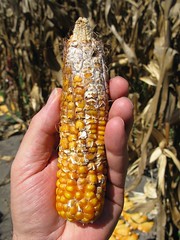
Fusarium ear rot on maize
Fusarium ear rot on maize (Photo credit: CIMMYT)

The trichothecenes (type A: T-2 toxin and type B: deoxynivalenol) are the largest group of mycotoxins which contaminate commodities such as corn, wheat, barley and oats. Trichothecenes, the most abundant source of contamination in cereal grains today, is due to Fusarium head blight which is primarily caused by type-B trichothecene producers (Foroud and Eudes 2009).

A survey in Africa and the Middle East about the occurrence of mycotoxins in commodities such as feeds and feed ingredients has been carried out. See the results ... 

The Global Miller, published and supported by the GFMT Magazine and the International Milling Directory from Perendale Publishers. And blogs are written by the staff of Grain & Feed Milling Technology daily. Get your copy of 'PPLAPP', our mobile web application which will allow you to view this blog and other useful information while on the move. 
Enhanced by Zemanta

April 19, 2011

Continuous corn disease considerations

When corn is planted back into corn residue, producers should be aware of the increased potential for certain diseases, says Doug Jardine, Kansas State Research and Extension plant pathologist. Not all diseases are affected by crop rotation, however.

The following is a brief summary from Jardine of how soil and leaf diseases differ between continuous corn and rotated corn.
  • With continuous corn, there is a greater probability of developing lesion nematode problems. 
  • Root rots, such as Fusarium root rot, could potentially be more severe. Root rot often develops into stalk rot. 
  • Root rots also are weather dependent, so just being in continuous corn does not necessarily lead to more root rot every year. 
  • Gray leaf spot could be more of a concern, since the disease overwinters on corn residue. Read more ...
This blog is written by Martin Little The Global Miller, published and supported by the GFMT Magazine and International Milling Directory from Perendale Publishers
Enhanced by Zemanta


See our data and privacy policy Click here